 TM
 EN
 RU
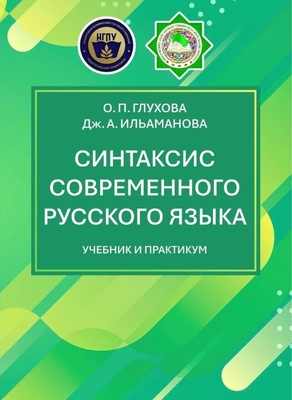
Dovletmammet Azadi Turkmen National Institute of World Languages and Naberezhnye Chelny State Pedagogical University (Russia) have published a joint textbook and workbook, “Syntax of the Modern Russian Language.” Prepared under their Memorandum of Cooperation, the edition was authored by educators from the Faculty of Russian Language and Literature and the Department of Russian and Tatar Philology (Faculty of History and Philology).The development of joint textbooks is outlined in the two universities’ 2026 Cooperation Intensification Roadmap. Published by Kartush Publishing House in Oryol, this edition was co-authored by O. Glukhova and J. Ilyamanova.
Designed as a comprehensive teaching and learning manual, the book combines both theoretical and practical materials essential for mastering a course in Modern Russian syntax. It systematically examines the core syntactic units of the Russian language — ranging from word combinations to complex syntactic wholes — drawing on both classical and contemporary grammatical theories. Each chapter concludes with a set of exercises aimed at practicing and reinforcing the material, suitable for both instructor-led classroom sessions and independent student study.
A distinctive feature of the textbook is its cultural approach to selecting material for analyzing a wide range of syntactic phenomena. The exercises draw not only on Russian classical literature — including A. Pushkin, M. Lermontov, I. Turgenev, L. Tolstoy, A. Chekhov, and A. Kuprin — but also on works by Turkmen authors in Russian translation (such as A. Kaushutov, O. Akmammedov, A. Durdyev, Kh. Deryaev, and S. Annasakhatov), as well as classical writers of the East (Saadi, Nasir Khusraw, Sanai, Ibn Yamin, and others). This selection of texts makes learning learner-centered and fosters a respectful attitude toward the cultural heritage of diverse peoples.
The textbook is designed for philology students, master’s students, doctoral students, Russian language teachers, and anyone interested in learning or teaching Russian. It helps organize their knowledge of syntax and build skills in syntactic text analysis, while also serving as a valuable methodological resource. Publishing this joint book is another clear sign of fruitful cooperation between Dovletmammet Azadi Turkmen National Institute of World Languages and Naberezhnye Chelny State Pedagogical University.
We would like to express our sincere gratitude to Hero-Arkadag and Arkadagly Hero Serdar for creating broad opportunities for effective scientific and creative work as well as the advancement of science and education. We would like to wish Hero-Arkadag and Arkadagly Hero Serdar sound health and great success in their noble endeavors for the prosperity of the Motherland!
Dovletmammet Azadi Turkmen National Institute of World Languages