 TM
 EN
 RU
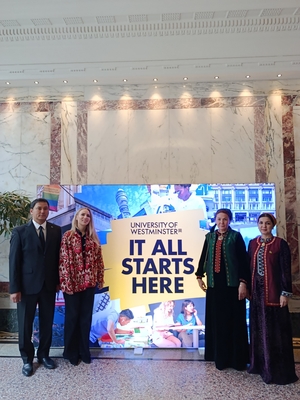
As part of the British Council’s educational project “AELLCA” aimed at enhancing the quality of English language teaching in Central Asia, faculty members from the International University for the Humanities and Development and Magtymguly Turkmen State University participated in an international professional development and cooperation program held at the University of Westminster in London, United Kingdom of Great Britain and Northern Ireland.
The professional development program at the University of Westminster comprised the following sections: “Inclusive Education and Institutionally Sustainable Practice”, “Sharing and Exploring Good Practice”, and “Sustaining Impact Beyond the Visit”.
The content of the professional development courses covered such topics as the core principles of teaching and learning at the University of Westminster, inclusive education and curriculum design, assessment systems for AI-enabled professions, collaboration, and positive intercultural exchange of experiences. Participants thoroughly familiarized themselves with teaching and learning methods in the UK higher education system, including student-centered learning, inclusive pedagogy, digital learning environments, principles of supporting diverse and multilingual student communities, curriculum design approaches, professional development activities, and contemporary approaches to assessment amidst evolving professional practices influenced by artificial intelligence.
Members of the Turkmen delegation were provided with the opportunity to observe teaching in practice, as well as to explore approaches to student engagement, inclusive pedagogy, classroom interaction with learners/students, reflective learning, and support for multilingual education. In addition, an exchange of views took place with the academic staff of the University of Westminster involved in curriculum enhancement and pedagogical innovation, and applicable good practices relating to student engagement, inclusion, and educational innovations were explored. Following detailed presentations by local specialists, opportunities were provided for Q&A sessions, discussions, and exchange of experience.
During the professional development courses, ways of sustaining educational innovation and good practice beyond individual projects were explored, including approaches to institutional embedding, collaboration, reflective practice, professional learning communities, and the development of longer-term institutional impact.
Furthermore, delegation members familiarized themselves with the features of the University of Westminster’s academic buildings. Representatives of Turkmenistan toured the university’s modern classrooms, innovative digital educational and research facilities, extensive library holdings, and practical laboratories for students. Additionally, an excursion to the Westminster Law School was organized for the delegation of the International University for the Humanities and Development. The Law School boasts a history of over 150 years and is renowned for its international-level research, specially equipped mock courtroom facilities, and innovative teaching methods.
The professional development courses conducted at the University of Westminster in London (United Kingdom of Great Britain and Northern Ireland) under the British Council’s “AELLCA” educational project served as an important platform for Turkmenistan, fostering the strengthening of international cooperation in education and the implementation of new international projects. This visit provided Turkmen educators and international partners with a valuable opportunity to acquire practical experience in applying modern educational methodologies and to further strengthen collaboration in language education. The participation of Turkmen representatives in this working visit reaffirmed our country’s commitment to modernizing the higher education system, improving foreign language teaching methodologies, integrating digital technologies and good practices into the national education system, and developing international cooperation.
International University for the Humanities and Development